Guides · United Kingdom · recruiters, HR & hiring managers
Salary band, benefits, and over-promising: compensation wording on the draft
“Competitive salary”, “£45k–£55k DOE”, “OTE £80k”, “unlimited holiday”, “market-leading pension” — compensation and benefits paragraphs are often pasted from last year’s template or the client’s aspirational brief. This guide helps you read what those lines are doing on the published advert, and tighten them before candidates apply. Wording hygiene only — not reward benchmarking, not contract review, not legal advice, and not Equality Act clearance.
Free limited check · £9.99 full PDF · £79.99/mo (up to 20)
Why salary and benefits lines matter on the advert body
Unlike person-spec filters (“must have ten years”, “native speaker”), compensation copy rarely triggers Equality Act wording scans — but it creates a different risk: candidate trust and shortlist waste. A candidate who applies on “£50k–£60k” and discovers the approved band tops at £48k will not treat the mismatch as a minor typo. An agency desk that publishes “fully flexible hybrid” when the client means “two days from home after probation” burns goodwill before first interview.
From April 2026, many UK employers must include a genuine salary or pay range on job adverts under the Employment Rights Act 2025. That statutory duty sits outside VacancyCheck — we do not verify pay compliance — but it makes vague compensation copy harder to defend on live boards. Even where a band is optional, clarity still beats boilerplate.
How to read salary band wording on a draft
When you see a pay line, ask three reading questions — not “is this lawful?” but “what is this line promising?”
- Does the band match the approved grade or rate card? If HR signed off £42k–£48k and the draft says £45k–£55k, fix the advert — not the candidate’s expectations later.
- Is base separated from variable? “OTE £70k” without a base figure is a common over-promise pattern on sales and recruitment-desk ads.
- Are “DOE”, “depending on experience”, and “negotiable” doing hidden work? They often widen the band in the candidate’s head beyond what shortlist will offer.
VacancyCheck may flag vague compensation phrases on some drafts; a flag is a prompt to tighten the line — not a ruling on statutory pay transparency.
Common salary patterns on UK job ads
| Pattern on draft | What it often means | Rewrite toward |
|---|---|---|
| “Competitive salary” | No number; copied from template | Approved band or hourly rate: “£42,000–£48,000 per annum” or “£14.50 per hour”. |
| “£45k–£55k DOE” | Wide band; experience used to justify low offer | Narrow to approved range; move “experience discussed at interview” out of the band if it misleads. |
| “OTE £80k+ uncapped” | Variable-heavy; base unstated | “Base £35k + commission. Typical first-year OTE £55k–£65k (2025 achievers).” Only if those figures are sourced. |
| “Up to £X” | Ceiling reads as target | “£X pro rata for part-time” or state FTE equivalent clearly — see part-time and flexible wording guide. |
| “Plus excellent benefits” | Unspecified package | Name two or three factual entitlements: pension %, holiday days, healthcare if offered. |
| “Salary review after six months” | Implied raise | Only if policy guarantees it; otherwise “salary reviewed annually in line with company policy”. |
Benefits and over-promising — the desk habit
Benefits copy fails in predictable ways on agency and in-house drafts:
- “Unlimited holiday” — often subject to manager approval and a soft cap. Name the policy or drop “unlimited”.
- “Fully flexible / work from anywhere” — may mean hybrid with core days. Tie to attendance reality; see the flexible and part-time guide.
- “Market-leading pension” — without a contribution %, it is marketing filler. State employer and employee percentages if published.
- “Free gym / bar / pool table” — perks that not every hire can use (shift workers, remote hires). Do not imply they are terms of employment.
- “Immediate start / ASAP bonus” — signing payments belong in the offer letter if conditional; on the advert, date the need honestly.
The pre-publish checklist step 5 already says benefits should match what you can offer. This page goes deeper on compensation phrasing specifically.
Fictional sample: before and after
On a fictional retail-operations draft, the benefits block might read:
“Competitive salary DOE · unlimited holiday · fully flexible working · market-leading pension · OTE £65k+”
A tightened desk rewrite — only if each line is true on the rate card and policy:
“£38,000–£42,000 per annum (FTE) · 25 days holiday + bank holidays · hybrid: minimum two days per week in our Manchester office · employer pension contribution 5% · store manager role: base £38k + quarterly bonus (typical £4k–£8k)”
That is the habit: name what is approved, split base from variable, drop adjectives that outrun policy. Whether the band attracts the right applicants is a hiring decision — not something a wording scan decides.
Pre-publish pass for compensation copy
- Pull the approved band or hourly rate from HR / the client rate card — not from last year’s advert.
- Highlight every “competitive”, “DOE”, “OTE”, and “unlimited” line on the draft.
- Split base, variable, and pro-rata wording for part-time posts.
- Replace benefits adjectives with two or three factual entitlements you will honour at offer.
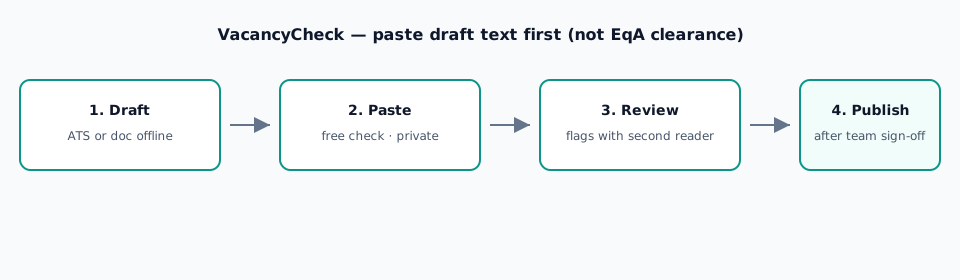
- Paste the revised draft into VacancyCheck before a multi-board blast. Free = limited on-screen flags; full PDF = £9.99; subscription = £79.99/mo up to 20 reports.
- Archive who signed off the published text. Prefer paste over live URL pre-publish.
Agency desks: if the client brief carries aspirational pay, edit before it goes live — do not paste the brief onto the board. See client brief vs agency job ad.
What this guide is not
- Not legal advice or a substitute for HR, reward, or legal counsel on pay transparency, contracts, or National Minimum Wage.
- Not Equality Act clearance or a compliance certificate.
- Not reward benchmarking, job evaluation, or pension scheme design.
- Not verification that published bands meet Employment Rights Act 2025 duties — instruct HR for statutory compliance.
Questions
Should I publish a salary band on every UK job advert?
From April 2026, many employers must include a genuine salary or pay range on job adverts under the Employment Rights Act 2025. Even where a band is optional, vague lines like “competitive salary” or “DOE” create candidate trust risk. Match the band to the approved grade or rate card before publish — VacancyCheck does not verify pay compliance.
Is “OTE £60k” the same as a salary band?
No. On-the-job-earnings and commission-heavy OTE lines are not the same as a base salary band. Split base, variable, and realistic range on the draft so candidates can compare roles. Over-promising OTE without a base figure is a wording hygiene issue — not something VacancyCheck clears.
Can I write “unlimited holiday” or “fully flexible” on a job ad?
Only if the policy genuinely matches. “Unlimited” holiday with a manager cap, or “flexible” working that still means five days on site, is over-promising on the advert body. Name the actual entitlement or attendance pattern. This guide is wording literacy — not HR policy sign-off or Equality Act clearance.
Does VacancyCheck verify my benefits copy?
No. VacancyCheck flags vague or over-promising compensation and benefits phrasing for human review. It does not check contracts, pension schemes, or whether the published band meets statutory pay-transparency duties.
Is this legal advice?
No. This guide and VacancyCheck reports are informational wording hygiene only. Not legal advice. Not Equality Act clearance. Instruct HR, reward, or legal counsel for pay benchmarking, contract terms, and statutory compliance.
Related guides
- Part-time hours, flexible working, and compressed hours on job ads
- Pre-publish job-ad wording checklist
- When the client’s brief should not become the live job ad
- A five-minute wording self-check for a busy recruiter desk
- Draft text first — why paste beats a live URL
Paste draft text — free check See pricing
Not legal advice. Not Equality Act clearance. Informational wording hygiene only. Last reviewed 23 September 2026.