Guides · United Kingdom · recruiters, HR & hiring managers
Part-time hours, flexible working, and compressed hours: attendance wording on the draft
“Part-time considered”, “fully flexible”, “hybrid working”, “4-day compressed week”, “school-hours only” — hours and flexibility lines are pasted onto drafts to widen the applicant pool, but vague wording often narrows trust instead. This guide helps you read what those phrases are doing on the published advert, and rewrite toward the actual shift. Wording hygiene only — not flexible-working policy, not reasonable-adjustment casework, not legal advice, and not Equality Act clearance.
Free limited check · £9.99 full PDF · £79.99/mo (up to 20)
Why hours and flexibility wording gets flagged
On agency and in-house desks, flexibility boilerplate is often shorthand for something concrete:
- Hybrid after probation — two days from home once passed, but the advert says “fully flexible”.
- Part-time on request — hiring manager will “consider” 0.8 FTE but the headcount is full-time.
- Compressed week for shift roles — four 10-hour days in warehouse ops, not office-style Friday off.
- Term-time or school-hours — education and care roles where the pattern is the product, not a perk.
- Core hours with flexi-start — 10:00–16:00 core, not “work whenever”.
Each can be written as contracted hours, FTE, and attendance pattern. “Flexible working available” is a promise without a shape — and on a live advert it deserves a human second look before publish. Public commentary (including EHRC guidance on flexible working and part-time parity) explains why vague or misleading hours copy can disadvantage carers, disabled applicants, and parents. This guide cites those as desk literacy — not as a ruling on your draft.
How to read the cue on a draft
When you see a part-time, flexible, or compressed-hours line, ask three reading questions:
- What are the contracted hours? State weekly hours, FTE equivalent, and whether the post is job-share, term-time, or shift-based.
- What is fixed vs negotiable? If only full-time is funded, do not publish “part-time considered” without hiring-manager sign-off.
- Does the salary line match the hours? Pro-rata and FTE salary should align — see salary band and benefits wording guide.
VacancyCheck may flag vague flexibility phrases on some drafts; a flag is a prompt to rewrite toward the shift — not a finding that the line is unlawful.
Common patterns on UK job ads
| Pattern on draft | What it often means | Rewrite toward |
|---|---|---|
| “Part-time considered” | Full-time hire with vague openness | “0.6–0.8 FTE available (22.5–30 hours). Salary pro rata £X–£Y FTE £45k–£50k.” Or drop if not true. |
| “Flexible working available” | Statutory right or informal hybrid | “Hybrid: minimum three days in our Leeds office (Mon–Wed core). Flexible start 08:00–10:00.” |
| “Fully remote / work from anywhere” | UK-only with quarterly travel | “Remote (UK). Quarterly team week in Bristol. Occasional client visits.” |
| “4-day compressed week” | Pattern not specified | “37.5 hours over four days (Mon–Thu). Friday non-working.” |
| “School hours / term-time only” | Actual contract type | “Term-time only (39 weeks). Hours 08:30–15:30 aligned to local school calendar.” |
| “Job share welcome” | Two hires on one FTE | “Job share considered — one FTE split across two post-holders. Apply individually or as a pair.” |
Distinct from transport and local-only lines — those name geography; this page names time and attendance.
Part-time vs flexible vs compressed — three different promises
Desks often conflate three ideas on one line:
- Part-time — contracted hours below full-time FTE; pay and benefits usually pro rata unless policy says otherwise.
- Flexible working — where or when work happens within agreed bounds (hybrid, staggered hours, flexi-time). May still be full-time FTE.
- Compressed hours — full-time hours worked over fewer days; common in public sector and some operational roles.
Writing “flexible part-time with compressed hours” without numbers invites mismatched applicants. Split them on the draft: hours first, flexibility second, salary pro rata third.
Fictional sample: before and after
On a fictional admin-support draft, the hours block might read:
“Full-time · flexible working · part-time considered · £32k”
A tightened desk rewrite — only if each line is true on the signed brief:
“Permanent · 37.5 hours per week · hybrid: two days from home after probation · 0.8 FTE (30 hours) open to discussion · £32,000 FTE (pro rata for part-time)”
That is the desk habit: name contracted hours, FTE, and attendance pattern — not “flexible” alone. Whether a candidate’s requested pattern can be accommodated is a human hiring decision.
Desk habit: hours before adjectives
- Confirm contracted hours and FTE with the hiring manager before drafting.
- Highlight every “flexible”, “part-time considered”, and “compressed” line.
- Replace adjectives with numbers: weekly hours, office days, core times, pro-rata band.
- Cross-check the salary line matches FTE and pro-rata wording.
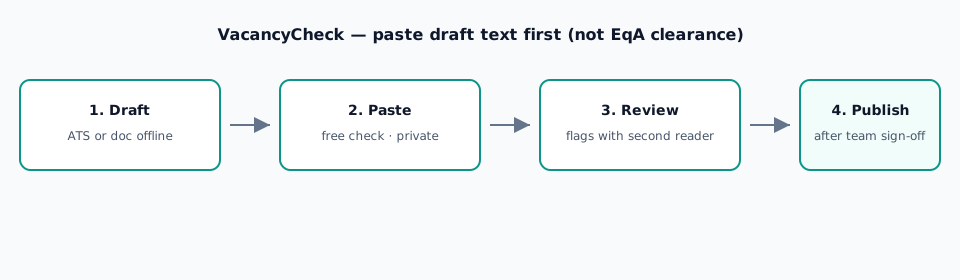
- Paste the revised draft into VacancyCheck before publish. Free = limited on-screen flags; full PDF = £9.99; subscription = £79.99/mo up to 20 reports.
- Archive who signed off the published text. See pre-publish checklist and five-minute desk self-check.
What this guide is not
- Not legal advice or a substitute for HR or legal counsel on flexible-working requests, part-time parity, or reasonable adjustments.
- Not Equality Act clearance or a compliance certificate.
- Not flexible-working policy design or occupational-health assessment.
- Not commentary on whether a refusal of part-time is justified — only on the published advert wording.
Questions
Should I write “part-time considered” on a full-time job advert?
Only if part-time is genuinely available at shortlist. Vague “consider” lines attract applicants who will discover the role is full-time only. State contracted hours, FTE equivalent, and pro-rata pay if part-time is open. VacancyCheck flags vague flexibility lines for human review — not as Equality Act clearance.
Is “flexible working available” enough on a job ad?
Often not. “Flexible” can mean hybrid days, staggered starts, or formal flexible-working requests after 26 weeks. Name the pattern: core hours, minimum office days, shift pattern, or job-share if offered. This guide is wording literacy — not a flexible-working policy sign-off.
How do I word compressed hours on a job advert?
State the contracted hours and the pattern if fixed: e.g. 36 hours over four days, or 37.5 hours Monday to Thursday with Friday off. Do not imply compressed hours are guaranteed if manager approval is required. Pro-rata salary should reference FTE.
Does VacancyCheck clear my flexible-working rewrite?
No. VacancyCheck is a wording risk report for human review. A flag on vague flexibility prompts you to name attendance reality; it is not clearance that the published advert is lawful or compliant.
Is this legal advice?
No. This guide and VacancyCheck reports are informational wording hygiene only. Not legal advice. Not Equality Act clearance. Instruct HR or legal counsel for flexible-working requests, part-time parity, and reasonable adjustments.
Related guides
- Salary band, benefits, and over-promising on job ad drafts
- Own-car, clean licence, and “local candidates only”
- Pre-publish job-ad wording checklist
- When the client’s brief should not become the live job ad
- Draft text first — why paste beats a live URL
Paste draft text — free check See pricing
Not legal advice. Not Equality Act clearance. Informational wording hygiene only. Last reviewed 23 September 2026.