Guides · United Kingdom · recruiters, HR & hiring managers
Remote, hybrid and on-site wording on UK job ads: a recruiter self-check
“Hybrid”, “fully remote”, “office-based with flexibility” — location lines are now standard on UK vacancy drafts, but they are often the least edited paragraph on the page. Vague working-pattern copy wastes applications, creates mismatched interviews, and can sit beside other wording that deserves a second look before publish. This guide is literacy for desks and hiring managers — not legal advice and not Equality Act clearance.
Free limited check · £9.99 full PDF · £79.99/mo (up to 20)
Why location wording matters on the advert
Candidates treat the title, pay band, and location/working-pattern block as a filter before they read the person spec. If the draft says “hybrid” but means three fixed office days, you lose people who assumed two days at home — and you attract people who cannot meet the on-site requirement. That is a clarity problem first; it also means other lines on the same draft (commute radius, driving licence, “local candidates preferred”) may never get the human review they need.
On agency desks, the client brief often says “flexible” while the contract and desk layout say something tighter. The live advert should describe what the hire will actually do in week one — not the shorthand from a kick-off call. See when the client brief should not become the live job ad for that split.
Three labels recruiters should make explicit
UK boards and careers sites use different field names, but candidates still look for a plain answer: where does the work happen?
- On-site / office-based — work is performed at a named site (or sites) for most or all contracted hours. Say which site, whether shifts vary, and whether “office-based” means a desk in a shared building or a shop floor, ward, or depot.
- Hybrid — some work at a site, some elsewhere. State how many on-site days (or which days), whether that pattern is fixed or team-led, and whether remote days require UK residency or a secure home setup.
- Remote / home-based — work is performed away from the employer’s premises for most hours. Say if “remote” still means occasional travel, client visits, or mandatory training days — “fully remote” rarely means zero travel in client-facing roles.
If the hiring manager has not decided, the advert should not pretend they have. “TBC” in the working-pattern line sends mixed signals; better to delay publish or label the role on-site until the pattern is signed off internally.
Common draft phrases and what to check
| Pattern on draft | Self-check question |
|---|---|
| “Hybrid working available” | Available to whom — everyone in the band, or after probation? How many days on-site? |
| “Flexible approach to remote working” | Flexible for the business or the individual? Any core hours or anchor days? |
| “Occasional office attendance” | Define occasional — once a month, once a quarter, or ad hoc at manager discretion? |
| “Must be within commutable distance” | Commutable from where — office postcode, client patch, or “reasonable distance” with no map? |
| “UK remote” vs “remote (EMEA)” | Right-to-work and tax sit outside this guide — but the advert should not imply a country restriction unless HR has confirmed the hire model. |
| Title says “Remote” but body says “on-site training fortnight” | Align title, location field, and first paragraph so a skim matches the spec. |
Hybrid and on-site roles often pick up transport lines in the same draft (“own car essential”, “must live locally”). Those deserve their own pass — they are job-task questions, not vibe. Treat a radius or licence line as a requirement only if week-one tasks truly need it; otherwise move it to preferences or drop it.
When “local only” sits next to hybrid copy
Desks sometimes stack a generous remote headline with a tight geography filter: “home-based but must live within 30 miles of Leeds”. Candidates read that as contradictory unless you explain why — on-call cover, kit collection, client visits, or statutory site access. One factual sentence (“two on-site days per month at LS1; remaining days home-based within UK”) beats a radius rule with no reason.
Public EHRC advertising guidance uses examples where eligibility is tied to a protected characteristic without objective justification; this guide does not apply those examples to your draft. The narrower desk lesson is: geography and attendance lines should describe the job’s operational need in plain language, not shorthand about who “fits” the commute culture.
Board fields vs body copy — keep them in sync
Job boards expose structured location and remote/hybrid/on-site tags. Recruiters often paste body copy from an old template while the board dropdown says something else. Before publish:
- Match the board’s location/working-type field to the first paragraph of the advert.
- Name the primary site (town or postcode area) even for hybrid and remote roles if there is any regular attendance.
- If pay is London-weighted but the role is “remote UK”, say so — mismatched pay and location lines confuse candidates and internal approvers.
- Re-read the title: “Remote customer success manager (Manchester)” should mean what it says in the body.
Step 5 of the pre-publish checklist covers benefits and process copy; working pattern belongs in the same pass so salary, hybrid rules, and application steps do not contradict each other.
Desk workflow before the ad goes live
- Hiring manager confirms on-site days, remote eligibility, and any travel — in writing, not on a call only.
- Draft writer replaces vague “flexible hybrid” with numbers and named sites.
- Second reader checks title, board fields, and body for the same story.
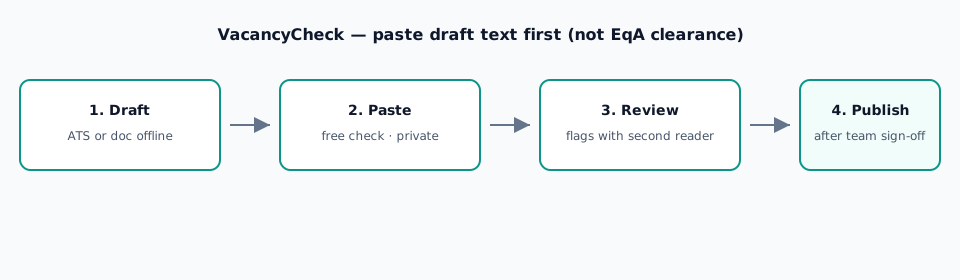
- Paste the final text into VacancyCheck — free limited check (1 per verified email per rolling week), full PDF £9.99, or £79.99/mo for up to 20 reports on busy desks.
- Archive the signed wording. Prefer paste pre-publish; a live URL check is retrospective only.
Location lines rarely appear alone. Scan the full draft with the wording patterns guide — especially where attendance requirements sit beside experience cut-offs or culture shorthand.
What this guide is not
- Not legal advice. Not guidance on right-to-work, immigration sponsorship, or tax residence.
- Not Equality Act clearance or a ruling on whether a radius or attendance rule is objectively justified.
- Not a policy template for hybrid working — only the published advert wording.
- Not a promise that clearer location copy removes all wording risk on the same draft.
Related guides
- Pre-publish job-ad wording checklist
- When the client’s brief should not become the live job ad
- Draft text first — why paste beats a live URL
- Wording patterns worth a self-check
Paste draft text — free check All guides
Not legal advice. Not Equality Act clearance. Informational wording hygiene only. Last reviewed 22 September 2026.