Guides · United Kingdom · recruiters, HR & hiring managers
“Recent graduate only” and first-role cut-offs on UK job ads: literacy for recruiters, not a verdict
“Recent graduate only”, “graduate only”, “first role essential”, “would suit someone in the first five years of their career” — life-stage and qualification cut-offs still appear on UK vacancy drafts, often copied from a client brief onto Indeed. This guide helps you read what those phrases are doing on the published advert, and rewrite toward skills, tasks, and named qualifications. Wording literacy only — not early-careers scheme design, not legal advice, and not Equality Act clearance.
Free limited check · £9.99 full PDF · £79.99/mo (up to 20)
Why graduate-only lines get flagged on a draft
On early-careers, staffing, and in-house desks, the graduate line is often shorthand for something concrete:
- Entry band — junior salary, training budget, or line-manager time.
- Qualification gate — a named degree or professional body membership is day-one essential.
- Scheme intake — a fixed graduate programme with cohort start dates.
- Task level — work that does not need prior sector experience.
Each of those can be written as skills, qualifications, or programme facts. “Recent graduate only” is a label about the person — and on a live advert it deserves a human second look before publish.
Official recruitment guidance treats “recent graduate” as an example of wording that is hard to justify on a general vacancy. ACAS on how to advertise a job and EHRC advertising guidance (including the FAQ on whether an employer can instruct an agency to advertise for a “young graduate”) are cited here as desk literacy — not as a ruling on your draft.
How to read the cue on a draft
When you see a graduate-only or first-role line, ask three reading questions — not “is this lawful?” but “what is this line trying to say?”
- Is there a named qualification or task behind it? If the body never lists degree subject, professional membership, or day-one duties, the graduate line may be doing all the work by itself.
- Could skills or experience replace the life-stage filter? “Suitable for candidates new to [sector] — full training provided” tells candidates what the role involves.
- Does the rest of the advert contradict it? An equal-opportunities footer beside a blunt “recent graduate only” is a common mismatch — see equal-opportunities line vs the title.
VacancyCheck flags phrases like recent graduate and numeric career cut-offs for human review — see flags on the sample full report (fictional Northern Logistics draft). A flag is a prompt to rewrite toward the work; it is not a finding that the line is unlawful.
Common patterns on UK job ads
| Pattern on draft | What it often means | Rewrite toward |
|---|---|---|
| “Recent graduate only” | Life-stage filter without a named qualification | Named degree or professional body if genuinely essential; otherwise “entry-level” plus day-one tasks. |
| “Graduate only” (non-scheme role) | Qualification shorthand on a general vacancy | “Degree in [subject] or equivalent experience in [X]” — or drop “only”. |
| “First role essential” / “must be first job” | Empty career-stage filter | “No prior experience in [sector] required — training provided” if that is the truth. |
| “Would suit someone in the first five years of their career” | Numeric downward cut-off | See years-of-experience cut-offs — name the programme or tasks instead. |
| “Young graduate for our trendy team” | Client brief copied verbatim | Skills and programme facts — see client brief vs agency job ad. |
Pattern overlap with age-coded and gendered job titles (“digital native”, “young team”) is common on the same draft. Step 3 on the pre-publish checklist asks you to scan for life-stage shorthand.
Fictional sample: before and after
On a typical early-careers draft, the person-spec says “recent graduate only” without naming a qualification or programme. A desk rewrite might move to task language:
“Entry-level role — suitable for candidates new to logistics. Full induction and forklift training provided. Degree not required.”
Or, if a qualification truly is day-one essential:
“Graduate trainee on our 2026 intake — you will rotate through warehouse, transport, and customer-service teams. Applications welcome from recent graduates in any discipline.”
That is the desk habit this guide is pointing at: replace the life-stage filter with qualifications, programme facts, or task language. Whether a candidate matches at shortlist is a human hiring decision — not something a wording scan decides.
Desk habit: write the qualification or task, not the life stage
- Highlight every “recent graduate”, “graduate only”, “first role”, or numeric career cut-off on the person spec.
- For each line, write one sentence: what qualification, programme, or day-one task needs this?
- Check the EO footer still matches the body — see EO line vs title.
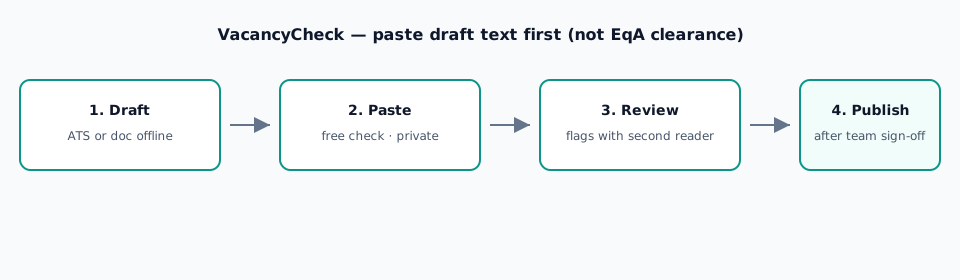
- Paste the revised draft into VacancyCheck before a multi-board blast. Free = limited on-screen flags (1 per verified email per rolling week); full PDF = £9.99; subscription = £79.99/mo up to 20 reports.
- Archive who signed off the published text. Prefer paste over live URL pre-publish.
Agency desks: if the client’s brief carries “young graduate for our trendy team”, edit the draft before it goes live — do not paste the brief onto the board.
What this guide is not
- Not legal advice or a substitute for HR or legal counsel on objective justification or shortlisting casework.
- Not Equality Act clearance or a compliance certificate.
- Not commentary on how to design graduate schemes, cohort sizes, or pay bands — only on the published advert wording.
- Not a recap of tribunal explainers or “is recent graduate lawful?” solicitor pieces — those SERPs are for lawyers, not desk rewrites.
- Not a finding about any named employer, agency, or client brief.
Related guides
- Years-of-experience cut-offs on UK job ads
- Age-coded and gendered job titles
- When the client’s brief should not become the live job ad
- Equal-opportunities line vs the title and must-haves
- Wording patterns worth a self-check
- Pre-publish job-ad wording checklist
Paste draft text — free check See pricing
Not legal advice. Not Equality Act clearance. Informational wording hygiene only. Last reviewed 21 September 2026.