Guides · United Kingdom · recruiters, HR & hiring managers
“Own transport” and driving-licence lines on UK job ads: rewrite toward the task, not a verdict
“Own transport essential”, “full UK driving licence required”, “must have own car and clean licence”, “local candidates only” — vehicle and geography lines still appear at the top of UK warehouse, field-sales, care, and mobile-engineer adverts. This guide helps you read what those phrases are doing on a draft, and whether you could describe the travel task instead. Wording literacy only — not transport policy, not disability-law advice, and not Equality Act clearance.
Free limited check · £9.99 full PDF · £79.99/mo (up to 20)
Why desks keep writing the blanket transport line
On industrial, field-sales, care, and mobile-service desks, the driving line is often a shortcut for something concrete:
- Multi-site cover — occasional shifts at a second depot with poor public transport.
- Daily route work — field sales, community nursing, or mobile engineering between addresses.
- On-call response — must reach a site within a set time outside normal hours.
- Company vehicle unavailable — pool car exists but not for every shift pattern.
Each of those can be written as travel frequency, notice period, and alternatives. “Own car essential” is a label about the person’s assets — and on a live advert it deserves a human second look before publish.
How to read the cue on a draft
When you see a blanket transport or licence line, ask three reading questions — not “is this lawful?” but “what is this line trying to say?”
- Is there a named travel task behind it? If the body never mentions sites visited, call-out times, or mileage, the driving line may be doing all the work by itself.
- Could frequency and alternatives replace ownership? “Occasional cover at our Leeds depot (advance notice; pool vehicle or taxi considered)” tells candidates what the shift involves.
- Does “local only” have a response-time reason? “Must reach [location] within 45 minutes for emergency call-outs” is a task; “local candidates only” without context is a geography filter — see flag 07 patterns on the sample full report.
VacancyCheck flags phrases like own car essential for human review — see flag 04 on the sample full report (fictional Northern Logistics draft). A flag is a prompt to rewrite toward the task; it is not a finding that the line is unlawful.
Common patterns on UK job ads
| Pattern on draft | What it often means | Rewrite toward |
|---|---|---|
| “Own transport / own car essential” | Unspecified travel without alternatives | Travel frequency, sites, notice period; pool vehicle / public transport / taxi if available. |
| “Full UK driving licence essential” | Licence as person filter, not task | “Daily multi-site visits required — driving essential” only if genuinely day-one critical; otherwise “licence useful”. |
| “Clean driving licence required” | Blanket licence condition | State why (company insurance, fleet policy) or move to “valid licence for category [X]” if the role uses a company vehicle. |
| “Must have own vehicle” (care / mobile roles) | Asset requirement without mileage or allowance | Routes per day, mileage allowance, company car eligibility, or pool vehicle schedule. |
| “Local candidates only” | Geography filter without task reason | Response-time or on-call requirement — or remove if commute is the candidate’s choice. |
Public hygiene lists (e.g. Sprintlaw’s “words to avoid”) treat unjustified “clean driving licence” lines as disability-adjacent wording to replace — this guide cites them as desk literacy, not as a ruling on your draft.
Fictional sample: before and after
On the fictional Northern Logistics excerpt in the sample full report, the draft says “own car essential” without naming travel frequency or alternatives. The sample rewrite moves to task language:
“Occasional cover at our second Leeds site (public transport links / pool vehicle available). Full UK driving licence useful but not essential.”
Where daily multi-site travel genuinely is day-one essential, keep the driving requirement — but name the task:
“Daily visits to 8–12 client sites across West Yorkshire — full UK driving licence and use of own vehicle required (mileage allowance paid).”
That is the desk habit this guide is pointing at: replace ownership with travel frequency, notice, and alternatives — or keep driving only where the task truly requires it.
Desk habit: write the travel task, not the asset
- Highlight every “own transport”, “own car”, “driving licence essential”, and “local only” line on the person spec.
- For each line, write one sentence: what travel frequency, site, or response time needs this?
- Check whether pool vehicles, public transport, or taxi options exist — and say so on the draft if they do.
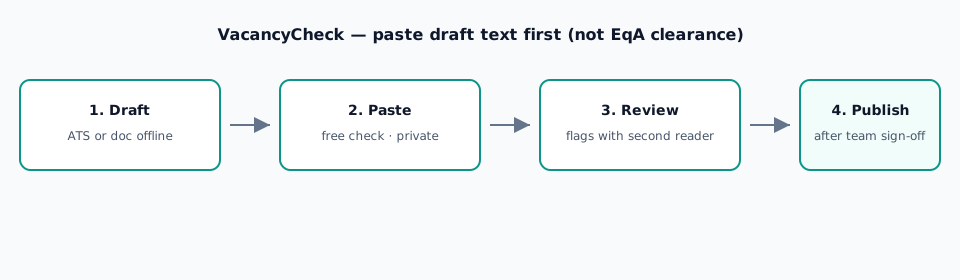
- Paste the revised draft into VacancyCheck before a multi-board blast. Free = limited on-screen flags (1 per verified email per rolling week); full PDF = £9.99; subscription = £79.99/mo up to 20 reports.
- Archive who signed off the published text. Prefer paste over live URL pre-publish.
Industrial and field-sales desks: “own car essential” is often template copy from an old brief. Edit before it goes live — do not paste the template onto the board.
What this guide is not
- Not legal advice or a substitute for HR or legal counsel on reasonable adjustments or shortlisting casework.
- Not Equality Act clearance or a compliance certificate.
- Not commentary on fleet policy, company-car tax, or mileage rates — only on the published advert wording.
- Not a recap of tribunal explainers or “is own car lawful?” solicitor pieces — those SERPs are for lawyers, not desk rewrites.
- Not a finding about any named employer, agency, or client brief.
Related guides
- “Fully fit” and able-bodied lines on warehouse job ads
- Years-of-experience cut-offs on UK job ads
- When the client’s brief should not become the live job ad
- Equal-opportunities line vs the title and must-haves
- Wording patterns worth a self-check
- Pre-publish job-ad wording checklist
Paste draft text — free check See pricing
Not legal advice. Not Equality Act clearance. Informational wording hygiene only. Last reviewed 21 September 2026.