Guides · United Kingdom · recruiters, HR & hiring managers
Apprenticeship level requirements on UK job ads: a recruiter self-check
“Level 3 apprenticeship required”, “degree apprenticeship preferred”, “must have completed a relevant apprenticeship” — qualification lines on UK vacancy drafts often mix RQF levels, branded standards, and training the employer is actually offering. This guide helps recruiters read those lines clearly and separate day-one essentials from marketing copy. Wording hygiene only — not legal advice and not Equality Act clearance.
Free limited check · £9.99 full PDF · £79.99/mo (up to 20)
Two different sentences that look alike
Apprenticeship wording on a draft usually falls into one of two buckets — and conflating them is a common pre-publish mistake:
- Entry requirement — the hire must already hold a completed apprenticeship, a named standard, or an equivalent qualification before day one.
- Training offer — the employer will enrol a successful candidate on an apprenticeship programme (often with funded off-the-job training).
A single advert can include both — “Level 3 qualified electrician; we support ongoing CPD” — but many drafts accidentally say “apprenticeship available” in the person spec while the title reads like an experienced hire. Candidates cannot tell which band you mean. Hiring managers cannot either, which is how “essential” lines get pasted from an old template without review.
RQF levels recruiters should be able to read
UK apprenticeship standards sit on the Regulated Qualifications Framework (RQF). You do not need to memorise every standard name, but you should know what the level number is trying to signal on the advert:
| Level on draft | Typical desk meaning | Self-check |
|---|---|---|
| Level 2 | Foundation / intermediate band — GCSE-grade equivalence in many sectors (e.g. hospitality, care, construction entry). | Is Level 2 truly essential on day one, or are you describing the programme you will put a new hire on? |
| Level 3 | Advanced / technician band — often A-level equivalence; common for supervisory trades, dental nursing, lab tech routes. | Name the standard or job tasks if you mean “qualified to X”, not just “Level 3”. |
| Level 4–5 | Higher apprenticeship band — foundation degree or HND equivalence in many frameworks. | Do not use “degree required” and “Level 4 apprenticeship essential” unless HR confirms both are needed. |
| Degree apprenticeship (Level 6–7) | Work-based degree or senior leader route — hire is often early-career or career-changer with university delivery alongside the job. | Say whether the degree is part of the offer or a qualification the candidate must already hold. |
Standard names change (reformed trailblazer titles, employer-specific labels). On the advert, prefer what the person must be able to do plus the minimum qualification where it is genuinely essential — not a internal programme code candidates cannot look up.
“Must have completed an apprenticeship” — read it twice
When a draft says completion is mandatory, ask what problem the line solves:
- Regulated or licensed work — some roles expect a completed apprenticeship or NVQ as evidence of occupational competence. Name the competence or registration, not only the word “apprenticeship”.
- Proxy for experience — the hiring manager wants “someone who has done the job before”. That is often a years-of-experience cut-off in disguise; rewrite toward tasks and outcomes.
- Age or career-stage shorthand — “apprentice-age only” or “young apprentice wanted” belongs nowhere on the live advert. Early-career intake is covered in the age-coded and gendered job titles guide; apprenticeship routes are open to adults at any age in UK policy — the advert should not imply otherwise.
Equivalent qualifications deserve one clear line: “Level 3 Electrical Installation (or equivalent demonstrable competence)” is easier to self-check than “must have served a full apprenticeship” with no definition of equivalent.
When the employer is offering an apprenticeship
Training-led adverts should lead with the band and what the hire does in year one:
- Title matches the band — “Apprentice …”, “Trainee …”, or “Graduate / degree apprenticeship …” — aligned with pay and essential requirements.
- Person spec lists what is essential at application (GCSE maths/English, right to work, driving licence only if week-one tasks need it).
- Benefits block describes the programme (standard name, typical duration, off-the-job training) without contradicting “no prior experience required” in the essentials list.
- Do not paste “degree essential” from a parallel experienced-hire template into an apprenticeship vacancy.
Agency desks: the client brief may say “we want someone cheap on an apprenticeship” while the signed programme is Level 3 with defined wage progression. The live advert carries the published wording — see client brief vs live job ad.
Overlap with degree and “graduate only” lines
Degree apprenticeships blur the line between graduate recruitment and work-based learning. Common draft clashes worth a human second look:
- “Graduate only” in the title with “degree apprenticeship — no degree required” in the body.
- “Minimum bachelor’s degree” listed as essential on a role marketed as a funded apprenticeship place.
- “Recent graduate” culture copy on the same draft as a Level 2 adult retraining programme.
Separate qualification essential at hire from qualification obtained during employment. If you mean “we will support you to Level 6”, that is an offer paragraph — not a must-have bullet unless HR says otherwise.
Pre-publish self-check for qualification lines
- Highlight every “essential”, “must”, and “required” in the person spec.
- For each apprenticeship or level line, write one sentence: what task on week one needs this credential?
- Move training-you-provide copy out of the essentials list into a “what we offer” section.
- Check title, pay band, and essentials tell the same seniority story.
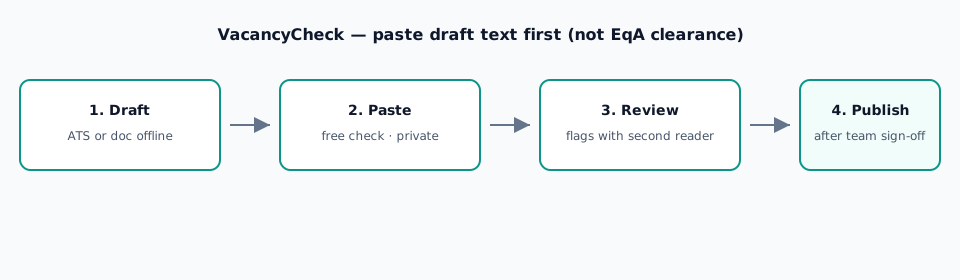
- Paste the revised draft into VacancyCheck before publish — free limited check, full PDF £9.99, or desk subscription £79.99/mo (up to 20 reports).
Run the same pass as step 3 of the pre-publish checklist (requirements vs preferences). Hard qualification gates often sit beside other patterns in the wording patterns guide — treat each flag as a rewrite prompt, not a verdict.
What this guide is not
- Not legal advice. Not guidance on apprenticeship levy, funding rules, or ESFA compliance.
- Not Equality Act clearance on whether a qualification requirement is objectively justified.
- Not a catalogue of every live apprenticeship standard — only how to read published advert wording.
- Not a comment on any real employer, training provider, or live vacancy.
Related guides
- Years-of-experience cut-offs on UK job ads
- Age-coded and gendered job titles
- Pre-publish job-ad wording checklist
- When the client’s brief should not become the live job ad
- Wording patterns worth a self-check
Paste draft text — free check All guides
Not legal advice. Not Equality Act clearance. Informational wording hygiene only. Last reviewed 22 September 2026.